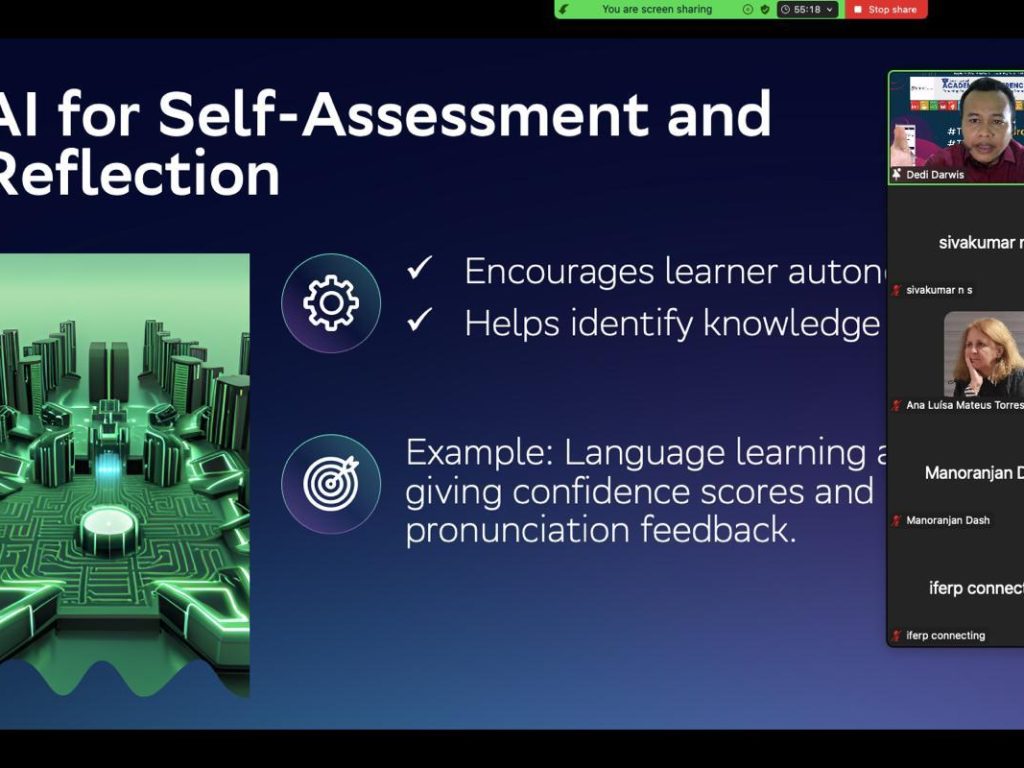
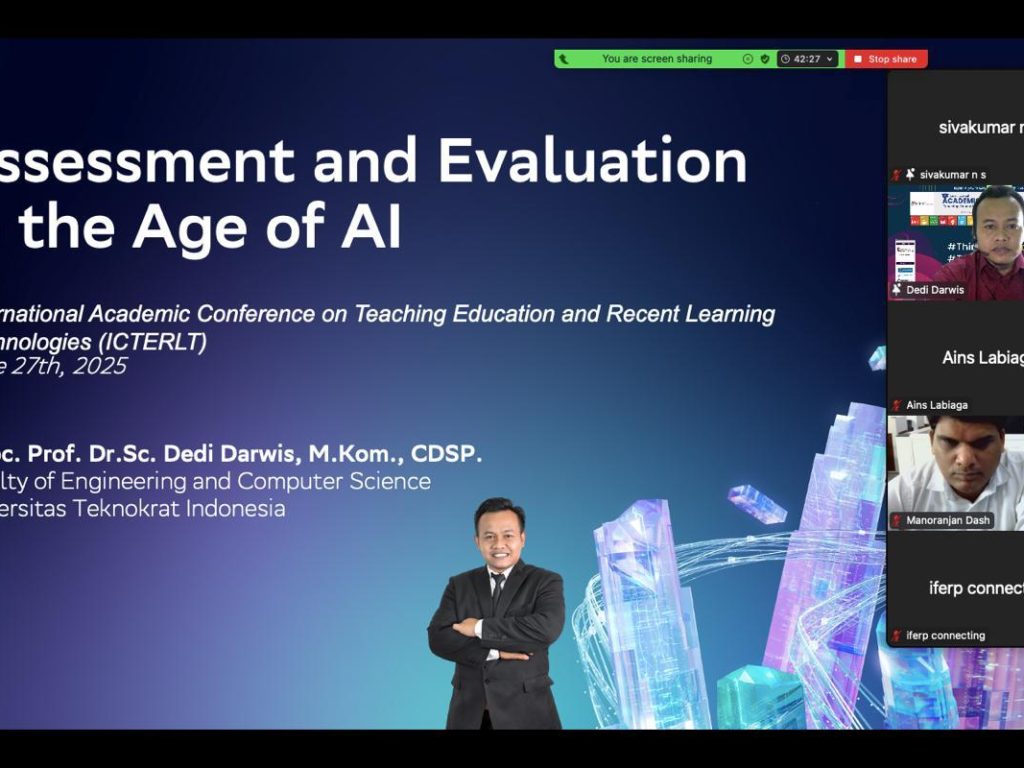
Bali, Indonesia — Another proud achievement has been added to the academic record of Universitas Teknokrat Indonesia. Dedi Darwis, a lecturer and Dean of the Faculty of Engineering and Computer Science (FTIK-UTI) at Universitas Teknokrat Indonesia, was invited as a Keynote Speaker at the International Academic Conference on Teaching Education and Recent Learning Technologies (ICTERLT) 2025.
This prestigious international seminar, organized by the India-based Institute For Educational Research and Publication (IFERP), was held in Bali, Indonesia, on June 26-27, 2025.
The event carried the main theme: “Education for Tomorrow: Trends, Challenges, and Opportunities Towards Sustainable Development Solutions”, highlighting global dynamics in the era of digital transformation and sustainability. ICTERLT served as a meeting point for academics, researchers, practitioners, and policymakers worldwide to discuss innovative approaches to education and the latest learning technologies.
Dedi Darwis, as one of the main keynote speakers, delivered a presentation titled “Assessment and Evaluation in the Age of AI”, a highly relevant topic addressing the current challenges in education. In his talk, Dedi explored how Artificial Intelligence (AI) is revolutionizing assessment and evaluation systems in education, offering intelligent technology-based solutions to measure learning outcomes adaptively and sustainably.
“Assessment is no longer just about measuring final results; it’s about understanding the learning process itself. AI enables us to analyze how students think, respond to challenges, and develop over time,” Dedi explained to hundreds of participants attending both onsite and virtually from around the world.
He also emphasized the importance of implementing continuous formative evaluation through digital systems that can adapt learning materials to individual student needs, making the learning process more inclusive, efficient, and impactful.
ICTERLT 2025 attracted leading global education figures. Other notable keynote speakers included:
Prof. Mohit Tiwari (Bharati Vidyapeeth’s College of Engineering, India) on AI integration in Learning Management Systems (LMS).
Dr. Roseline Oluwaseun Ogundokun (Tshwane University of Technology, Nigeria) on STEM education for developing countries.
Assoc. Prof. Dr. Ana Luisa Mateus Oliveira Chanca Torres (Polytechnic University of Santarém, Portugal) on transformative pedagogy and sustainable learning.
Dr. Greg McVerry (Southern Connecticut State University, USA) on digital literacy and critical thinking in the social media era.
Their contributions addressed pressing global education challenges amidst rapid technological and social change.
Dedi Darwis is no stranger to educational innovation and technology. As a lecturer and active researcher at Universitas Teknokrat Indonesia, he is recognized for various research projects and community service initiatives focusing on intelligent technology applications. Notably, his project “DigiLearnHub”, funded by the Indonesian Ministry of Education, aims to develop smart systems for education.
He has also been a keynote speaker at international forums such as the AI-Journey Conference in Moscow, Russia (2023 and 2024), cementing his position as a thought leader in education and technology.
In his session at ICTERLT 2025, Dedi highlighted Indonesia’s efforts to adapt to digital technology in education, particularly through the Merdeka Belajar (Freedom to Learn) policy and AI integration in national assessments and higher education. He noted that Indonesia has a significant opportunity to become a pioneer in AI-based assessment systems in Southeast Asia, provided there is a strong commitment to teacher capacity building, digital infrastructure, and visionary policymaking.
“We must not remain mere consumers of technology but become producers of technology-based education solutions. Our human resources and socio-cultural diversity are key assets for developing contextual and inclusive AI systems,” Dedi stated during the panel discussion.
His participation in ICTERLT 2025 underscores Universitas Teknokrat Indonesia’s commitment to supporting the internationalization of higher education. The university consistently encourages lecturers and students to engage in global academic activities, including international publications, cross-country research collaborations, and participation in international forums.
Dr. Mahathir Muhammad, Vice Rector of Universitas Teknokrat Indonesia, expressed pride and appreciation for Dedi Darwis’s achievement:
“This reflects our commitment to nurturing outstanding lecturers who can compete and contribute at the international level. We hope this accomplishment inspires other lecturers and students to keep innovating and tackling the challenges of the times.”
In closing, Dedi invited researchers and educational institutions worldwide to collaborate in developing intelligent assessment technologies. He proposed forming an international network for AI-based assessment development, aiming to create a platform for exchanging ideas, innovations, and supportive policies.
“We need to build a global ecosystem that promotes data-driven and ethical education assessment. AI should empower educational equity, not undermine it. Cross-country collaboration is the key to adaptive and fair education systems,” Dedi concluded, receiving a resounding applause from conference participants.
 ID
ID
 EN
EN